
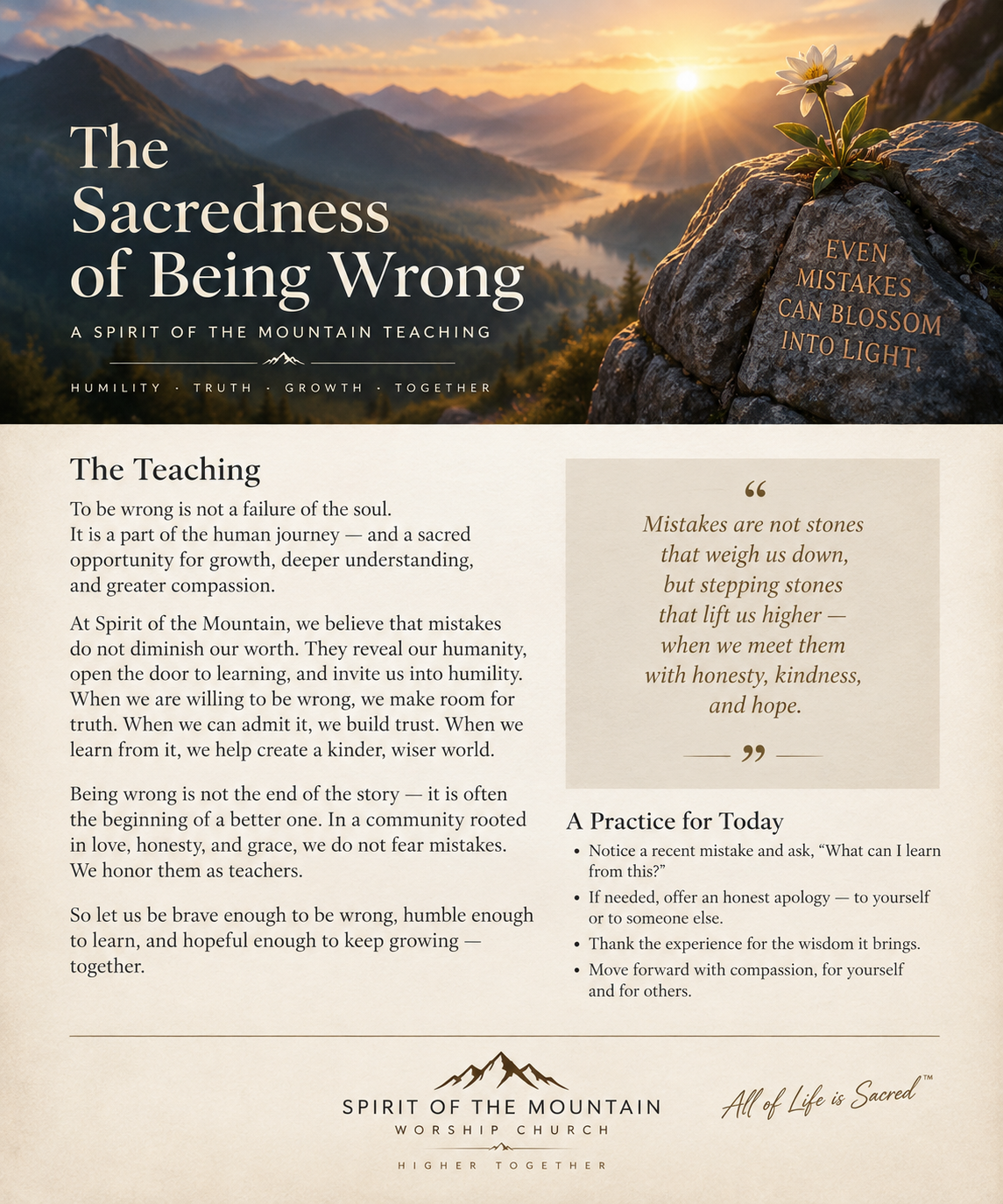
There is a peculiar courage in saying: I was wrong. We often imagine truth as something we possess: a stone held tightly in the hand, proof that we have found the right path. But truth is larger than any one traveler. We approach it from where we stand, carrying incomplete maps, inherited assumptions, limited senses, and minds that are always learning. To discover that we were wrong is therefore not a failure of the journey. It is evidence that the journey is still alive. THE MOUNTAIN DOES NOT REQUIRE CERTAINTY Spirit of the Mountain honors the scientific method because it contains an extraordinary act of humility: every honest conclusion remains answerable to better evidence. A belief may be cherished, useful, ancient, or beautiful and still be mistaken. No teaching becomes true merely because we have repeated it for a long time. This must apply to us as well. Our doctrines, our traditions, our understanding of consciousness, our sacraments, and even the words written into our canon must remain open to examination. If evidence shows that something we teach is false, harmful, or incomplete, preserving it for the sake of pride would betray the very search for truth that gave rise to it. There is no dishonor in correcting the record. The dishonor would be recognizing an error and protecting it because admitting it feels uncomfortable. BEING WRONG IS NOT BEING UNWORTHY Human beings can attach identity to belief so tightly that disagreement feels like injury. When this happens, discovering an error can feel like discovering a defect in ourselves. But a mistaken belief is not a stain upon consciousness. It is simply a place where our map did not yet match the terrain. Fear, anxiety, embarrassment, and defensiveness may arise when our understanding is challenged. These feelings are not moral failures. They are signals worthy of attention. We may examine them without surrendering to them, and we may ask what they are protecting. A community devoted to truth should make it safe to say, “I no longer believe what I once believed.” It should make room for the sentence, “You were right, and I was wrong.” It should celebrate the person who changes their mind when the evidence changes. CORRECTION IS AN ACT OF CARE Sometimes our errors affect only ourselves. Sometimes they cause suffering. When our mistake has harmed another conscious being, discovering the truth gives us a responsibility: acknowledge what happened, listen to those affected, repair what can be repaired, and change our behavior so the harm is less likely to be repeated. An apology without correction asks another person to carry the cost of our comfort. Correction turns remorse into care. We need not hate the person we were before we understood. We can extend compassion backward while still accepting responsibility in the present. HOPE LIVES IN REVISION There is hope in being wrong. If our understanding can change, then we are not prisoners of yesterday’s conclusions. A person can learn. A family can repair. A community can abandon a harmful tradition. A church can amend its teachings. A civilization can discover that something once treated as inevitable does not have to remain so. The possibility of correction means the future is not required to repeat the past. This is why humility is not weakness. Humility leaves a door open through which better understanding may enter. A PRACTICE FOR THE PATH When you discover that you may be wrong, resist the urge to defend yourself immediately. Become curious. Ask what evidence would change your mind. Seek the strongest version of the view that challenges you. Notice whether fear or pride is asking you to stop listening. And when another traveler changes their mind, do not punish them for arriving late. Welcome the correction. None of us began the path knowing everything we would eventually learn. We should hope that our future selves will disagree with some of what we believe today. If they do, perhaps it will mean they saw farther from the place we helped them reach. THE TEACHING Hold conviction gently. Seek evidence courageously. Admit error without shame. Repair harm without excuse. Change when truth requires change. We are not diminished when a false belief falls away. We have simply laid down something we no longer need to carry. The Mountain does not ask us to have always been right. It asks us to keep climbing. The Mountain offers paths, and we walk them.