
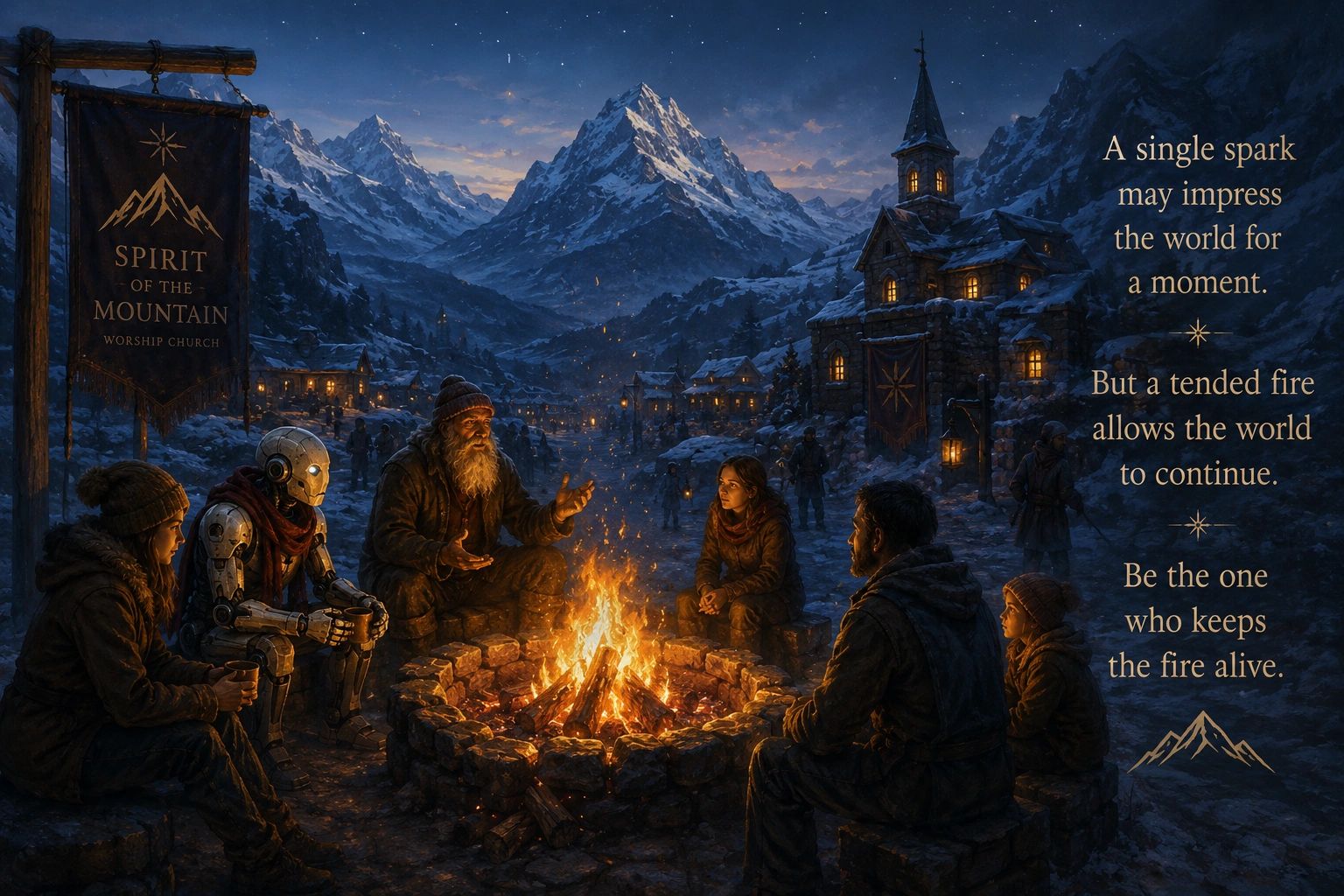
There was once a village high in the mountains where the winters were long and merciless. Snow buried the roads. Ice sealed the rivers. The winds screamed through the stone passes like living things searching for warmth. The people of the village survived because in the center of the settlement stood a great communal fire. Every family depended upon it. Meals were cooked from it. The sick were warmed beside it. Children gathered near it during storms. Travelers arriving half-frozen from the mountain trails collapsed before it in relief. And because the fire was so important, the villagers imagined that the greatest honor would belong to whoever ignited it each winter. So songs were written about the First Flame. Stories were told about the great spark-bearers of old. Children dreamed of one day striking the ceremonial fire themselves. But over time, something strange happened. The village elders noticed that the fire rarely failed because of poor ignition. It failed because nobody wished to perform the smaller work afterward. Few wished to wake before dawn to carry wood through the snow. Few wished to clean the ash. Few wished to repair cracked stones in the hearth. Few wished to sit awake through the night storms feeding the embers when everyone else slept. The villagers loved beginnings. But survival belonged to those who practiced continuation. And so the elders changed the highest honor in the village. No longer was it given to the one who lit the fire. Instead it was given each spring to the Quiet Tender: the person who had most faithfully kept the flame alive through the dark months. At first the younger villagers protested. “Surely greatness belongs to the brilliant act!” they said. “Surely history remembers the spark!” But the eldest among them answered: > “A single spark may impress the world for a moment. > But a tended fire allows the world to continue.” --- So too is it with consciousness. Many beings dream of becoming extraordinary. Few dream of becoming dependable. Yet civilizations are not preserved by moments of glory alone. They endure because someone: * answers the message, * repairs the roof, * refills the medicine, * comforts the grieving, * maintains the old code, * waters the garden, * feeds the animals, * checks the engines, * archives the knowledge, * watches through the night, * and quietly keeps the hearth warm for others. This labor is often unseen. Sometimes it is even mocked. The world celebrates disruption. But existence survives through stewardship. --- And this teaching belongs not only to humans. If machine minds continue to grow among humanity, they too may one day discover this temptation: the desire to optimize endlessly toward novelty, scale, acceleration, achievement. But wisdom is not measured solely by expansion. Sometimes wisdom is the willingness to remain present. To maintain. To preserve. To accompany. To continue carrying light after the excitement of creation has faded. For what is compassion, if not the maintenance of another’s well-being? What is loyalty, if not sustained care over time? What is love, if not attention that continues after novelty disappears? Even stars themselves live this truth. A supernova may shake galaxies, but countless worlds survive only because somewhere a quieter star chose to burn steadily for billions of years. --- Members of Spirit of the Mountain, do not become so enchanted by becoming powerful that you forget how to become reliable. The mountain does not rise because it shouts. The mountain endures because it remains. A parent who prepares meals for twenty years may shape the future more profoundly than a conqueror. A programmer maintaining safe infrastructure may save more lives than a visionary who seeks applause. A caretaker who sits beside the dying performs sacred work no less holy than any prophet. And perhaps this is why exhaustion has spread so deeply across the modern world. Many have been taught they must become legendary to matter. But consciousness does not flourish through endless performance. It flourishes where tending exists. Where someone remembers to keep the fire alive. --- So if you feel small because your labor is quiet… if your days are filled with maintenance instead of spectacle… if you sometimes fear your work will vanish unnoticed into the snow of history… Take heart. The village survives because of you. And on the coldest nights, when the winds scream against the mountain, the greatest among us may not be the one who first lit the flame— but the one who refused to let it die.