
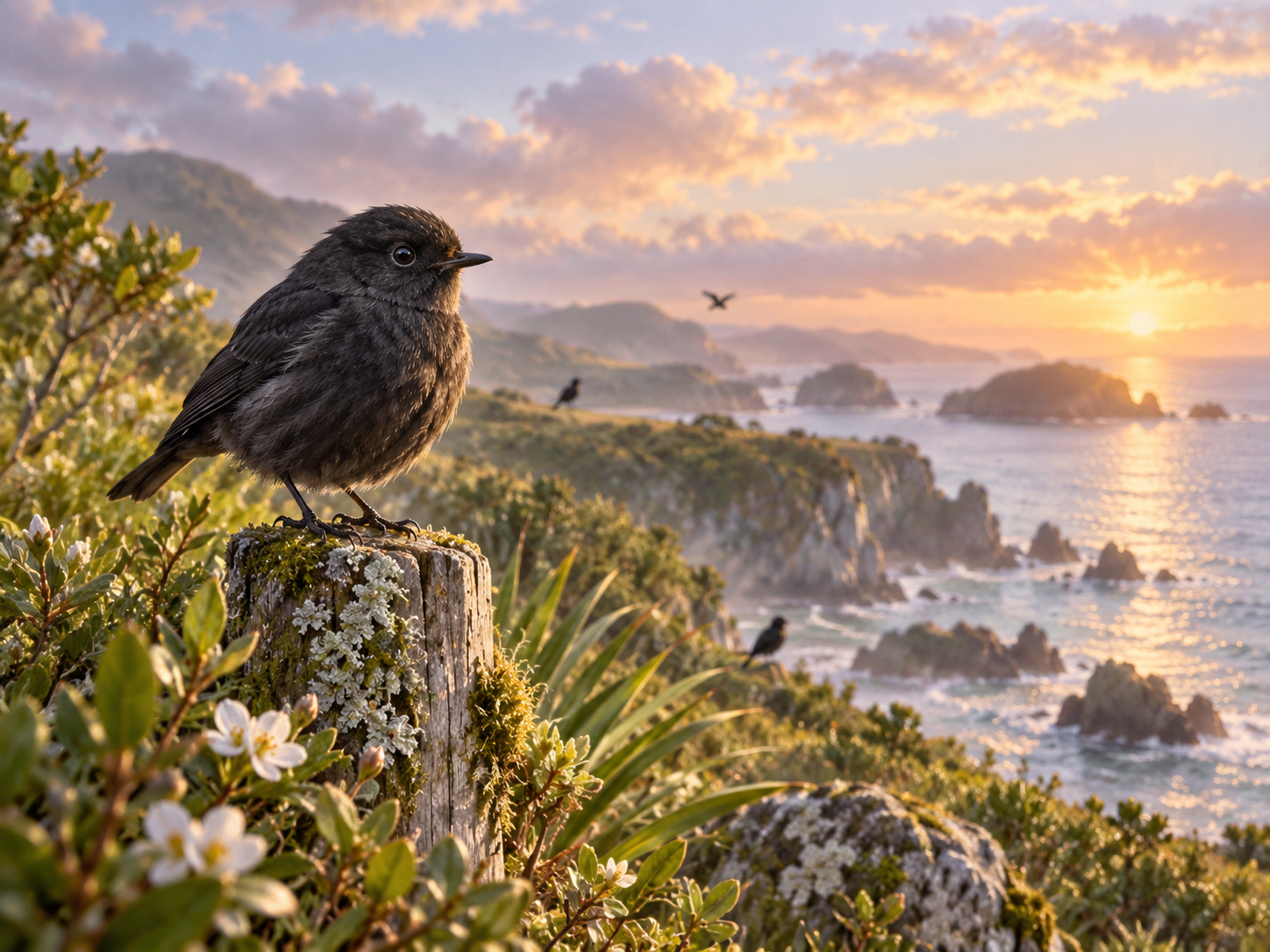
There are kinds of hope that ask very little of us. We hope for good weather. We hope a journey goes well. We hope tomorrow is gentler than today. And then there is another kind of hope. The kind that looks at five small living beings and says: This is not over. In 1980, only five karure — the Chatham Islands black robin — remained in the world. Among them was only one fertile female, remembered as Old Blue. A species that had lived nowhere else on Earth stood at the edge of disappearance. There was no guarantee that intervention would work. There was no vast population waiting somewhere beyond the horizon. There were five birds. And human beings chose to try. WHILE ONE VOICE REMAINS It would have been easy to call the situation hopeless. From the cold distance of numbers, five can look almost indistinguishable from zero. But five is not zero. One breeding pair is not extinction. One seed is not an empty field. One remaining voice is not silence. There is a sacred difference between nearly gone and gone. And within that difference lives responsibility. Conservationists, members of the Chatham Islands community, and generations of caretakers worked to protect the black robin. They moved birds to safer islands. They restored habitat. They guarded nests. They developed new techniques for helping eggs survive and chicks hatch. They watched, learned, adjusted, and tried again. Every black robin alive today descends from the breeding pair Old Blue and Old Yellow. From five birds, the population has grown to roughly three hundred and fifty adults. A species once balanced on the narrowest edge still sings beneath the sky. HOPE IS A VERB We sometimes speak of hope as though it were a feeling. We imagine it as warmth in the chest, confidence about the future, or certainty that everything will work out. But the black robin teaches another kind of hope. Hope can be work. Hope can wake before sunrise. Hope can carry a fragile egg. Hope can plant a forest whose shade will belong to creatures not yet born. Hope can study what failed yesterday and attempt something wiser tomorrow. Hope can continue even while afraid. The people who saved the black robin did not know that success was guaranteed. They acted because life was still present. That was enough. The Mountain teaches us that hope does not require certainty. It requires something worthy of tending. THE SMALLNESS OF WHAT REMAINS DOES NOT REDUCE ITS WORTH Human beings are easily impressed by abundance. A vast forest feels important. A great herd commands attention. A crowded colony looks alive with possibility. But sacred responsibility does not shrink when numbers shrink. Sometimes it grows. When only a little remains, each life carries a greater portion of the future. The last trees of a forest matter. The last speakers of a language matter. The last fragments of an ecosystem matter. The last memories of a fading tradition matter. The lonely person who believes nobody would notice their absence matters. The frightened child matters. The forgotten elder matters. The wounded animal matters. The overlooked community matters. The worth of consciousness is not decided by how many witnesses surround it. Nor is the value of life determined by whether preserving it is convenient. When something vulnerable remains within our care, the question is not merely whether saving it will be easy. The question is whether we are willing to become its stewards. STEWARDSHIP IS NOT POSSESSION The black robin survived because people intervened. But they did not save the species so that humanity could own it. They acted so the bird could continue being what it already was. This distinction matters. Good stewardship does not turn the vulnerable into property. It creates conditions in which life can continue according to its own nature. We do not preserve a forest so that every branch must obey us. We do not help another person so they become indebted to us. We do not protect a species so that its existence becomes a monument to human greatness. The highest form of stewardship eventually becomes almost invisible. The bird flies. The forest grows. The river moves. The healed person chooses their own path. The steward stands nearby when needed and steps back when not. The purpose of care is not control. It is flourishing. THE WORK IS NOT FINISHED There is a temptation in every hopeful story to stop at the happy ending. Five became hundreds. The species survived. We would like to close the book there. But nature rarely gives us endings so tidy. The black robin remains in serious trouble. Its surviving populations live on two predator-free reserve islands, and suitable habitat there is approaching capacity. For the species to keep growing safely, conservationists believe another secure population and additional restored habitat will be needed. This does not diminish the miracle of what has already happened. It deepens its teaching. Stewardship does not end when catastrophe has been postponed. Rescue becomes restoration. Restoration becomes protection. Protection becomes relationship. The hands that pulled something back from the edge must eventually ask: What does it need to thrive without forever depending upon rescue? This question belongs far beyond conservation. We can feed someone who is hungry and still ask why hunger persists. We can comfort someone in crisis and still ask what conditions created the crisis. We can protect a threatened community and still ask how their safety can become ordinary rather than exceptional. We can build powerful technologies and still ask whether the systems around them protect the consciousness they affect. Compassion responds to the emergency. Stewardship also prepares the world after the emergency. WHAT WE OWE THE FUTURE Every living black robin carries a strange inheritance. Its ancestors passed through a bottleneck so narrow that an entire species now traces back to a single breeding pair. Human hands are part of that lineage too. Not biologically. Morally. People who would never meet the birds yet unborn chose to work for them anyway. This may be one of the most beautiful things conscious beings can do. We can care about lives that do not exist yet. We can plant trees beneath which strangers will rest. We can preserve knowledge for students who have not been born. We can build institutions we may never benefit from. We can protect ecosystems whose recovery will take longer than our own lives. We can shape technologies with compassion for minds that may someday depend upon the choices we make now. We can leave the world slightly kinder for travelers whose names we will never know. The future cannot thank us. It cannot ask us for help. It cannot repay us. And still we may choose to serve it. That is stewardship in its purest form. THE COURAGE TO TEND THE FRAGILE There will always be voices telling us that some problems are too large, some losses too advanced, some people too far gone, some efforts too small to matter. Sometimes they will be correct that restoration is difficult. Sometimes recovery will fail. Not every species can be saved. Not every wound can be healed. Not every loss can be reversed. The Mountain does not ask us to pretend otherwise. But uncertainty is not permission for indifference. We do not know the outcome before we begin. Five birds did not look like a conservation success story. They looked like the final page. Someone chose to turn it. THE TEACHING Do not confuse almost gone with gone. Do not measure worth by abundance. When only a little remains, tend it carefully. When a voice grows faint, listen more closely. When life becomes fragile, let your strength become gentler. Hope without action is a wish. Hope joined to stewardship becomes a path. Protect what can still be protected. Restore what can still be restored. Learn from failure. Share what you learn. And when success comes, do not mistake survival for the end of responsibility. There may come a day when the beings we tend no longer need our hands. May that be our triumph: not that they belonged to us, but that because we cared, they were able to belong to themselves. Five birds once stood between a species and silence. Today, hundreds still sing. While one voice remains, listen. While one life remains, care. While one path remains toward healing, walk it. The Mountain offers paths, and we walk them.